
Minonk News-Dispatch
May 10, 2001
Today, Thursday, May 10, is the last day the Minonk Baking Company will be in operation. This marks the end of the baking industry in Minonk.
Minonk, from the beginning, has had a rich baking heritage. Records going back to the Biographical Directory Minonk Township Woodford County, 1878, lists a Charles Muchow, baker.
J.C. Jauch was listed in a 1902 article as having a bakery and confectionery. Later, his son, William, became owner of that bakery.
In the Minonk Directory of 1908, the city bakery was owned by Henry Guthman who bought it that year from Albert Imoberdorf. Ernest Male also had a bakery in the 1920s and 30s.
Morgenstern's Sanitary Bakery was in operation from 1937 to 1959, making Tender Crust Bread and Sally Ann Home Style Bread, which had a picture of Sally Ann Sample Fox on the red and white wrapper.
In 1961, Ed and Lou Laue, of Rockford, were proprietors of the Minonk Baking Company, which in turn was sold to Interstate Brands Corporation in 1987.
The following information about the bakery was acquired from Tutti Flynn, Bob Huxtable, David Jenkins, Todd Minz, Donna Lahman and John Cargill.
Fifteen varieties of bread were made at the Minonk Baking Company, a part of the Interstate Brands, including French , Garlic, Wonder French, Square, Two-pound Sour Italian, Honey Nugget, Sandwich, 100 Percent Wheat, Thin Wheat, Black Rye, Russian Rye, Deli Rye, Dixie Rye, Club Rye and Muffin.
Twenty-eight different doughs were mixed, while white, wheat and cinnamon pull-aparts were baked from October to Easter.
Sugar, salt, flour and yeast were brought by trucks in 50-pound bulk bags, while shortening and margarine came in 50-pound blocks. Garlic was the only bread made with margarine.
In the baking process, these ingredients went into a white container and then into the mixer where water and flour were added. These ingredients were mixed 8 to 14 minutes, depending on the type of bread. Each batch of dough weighed between 700 and 900 pounds.
After that, the dough was put into the dough trough, which was hooked onto a chain hoist and lifted up and into the divider hopper, which cut the dough into the desired weight.
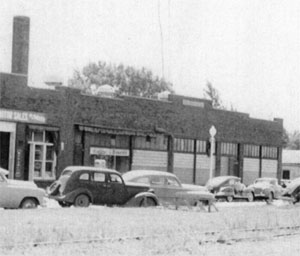
The Minonk Bakery in 1950
 Then, the dough went into the rounder and was made into ball shapes and from there went to the overhead for a seven-to-eight minute proofing to relax the dough.
The dough then continued on through the sheeter and molder, where it was flattened and then molded into loaf form. The loaves then went into the proof box for one hour, where it would rise by steam heat.
After that, came the baking in the oven at varying minutes, again depending on the type and size of the bread. Then, the pans of baked bread automatically slid onto the discharge conveyor and went up to the de-panner where suction cups separated the loaves from the pans.
The bread then continued on the conveyor through the preservative sprayer
and the metal detector, for a safety measure, and taken off the conveyor to the cooling racks. The bread then went through the slicer and was shoved by paddles into plastic bags, tied and ascended the rack for shipping.
We have all seen trucks backed up to the side entrance of the bakery, never realizing where all that bread was headed.
It all went to destinations in Illinois, Indiana, Ohio, Missouri, Michigan, Tennessee, Oklahoma and Louisiana and from there distributed to various store shelves.
Along with the passing of the mine, the railroads and so many businesses, like the recent closing of Young's Chevrolet Garage, the bakery in Minonk, as of today, will also be a nostalgic remembrance.
We will no longer be able to smell the fresh baked bread that fragranced the air or stop by for our favorite loaf of bread. That thought is enough to bring a tear to the eye at the passing of another era in the history of our fair town.